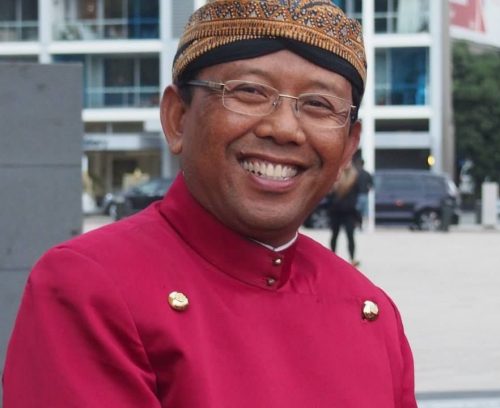
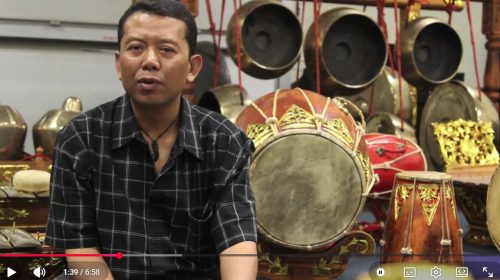
 Joko Susilo is an esteemed dhalang (Javanese shadow puppeteer) residing in Dunedin, New Zealand since 1993, but regularly performing and teaching around the world. He is skilled in all the arts of the dhalang encompassing expert puppet manipulation, character voicing, narration, singing, directing the gamelan accompaniment, designing and making shadow puppets, and directing and developing collaborative projects.
Background
Joko comes from a long line of dhalang, being the eighth generation in his family to perform the art of wayang kulit. His father began performing at the age of twelve years and studied shadow puppetry at the Kraton Kasunanan (palace), in Solo in 1952. His mother was also from a musical family and played gamelan from a very young age.
Joko was born in the village of Mojopuro in Central Java. He and his four sisters were all taught to play gamelan and to perform Javanese dance.
When Joko was three years old, his father began to take him to his wayang performances and he began to develop a knowledge of the stories, characters and gamelan melodies. At the age of 10, he performed his first all-night wayang kulit play (filling in for his father who was accidentally double-booked).
Joko went on to study the art of shadow puppetry (pedalangan) at the tertiary institution of Sekolah Tinggi Seni Indonesia (STSI) in Solo, graduating in 1986. He then became a lecturer in the pedalangan department and continued to perform all-night wayang kulit until moving to New Zealand with his kiwi wife.
Joko has been based in Dunedin since 1993, teaching with the music department and running a community gamelan group while pursuing higher education. He completed his PhD in the year 2000: “A musical ethnography of the Ruwatan performance in Central Java: tradition and change”.
He performs regularly in New Zealand with Gamelan Padhang Moncar (Wellington) and his own Puspawarna Gamelan group (Dunedin). He is the patron of The First Smile Cirebon gamelan in Wellington which was originally brought to New Zealand by Allan Thomas in 1974 with a complete set of wayang kulit puppets.
International activities
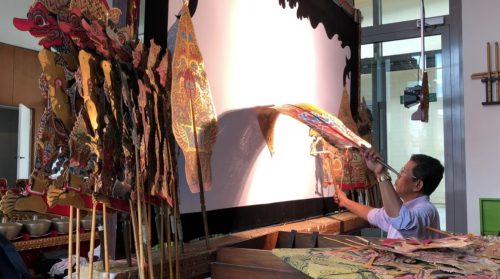
He is also in demand internationally and has performed widely in the USA, UK, Australia and across Europe over the years:
-
- US appearances include with Gamelan Kusuma Laras (New York), Dartmouth gamelan ensembles, and the Schubert Club in Minnesota.
- In the UK, he has performed with the South Bank Gamelan Players and in Glasgow with Gamelan Naga Mas where he performed numerous shows including colloborations with Matthew Isaac Cohen, traditional Javanese wayang and wayang karetao in a year-long residency.
- Australian appearances have included shows at Flinders University (Adelaide), University of Tasmania, Griffith University (Queensland) and with Melbourne Community Gamelan.
- In Europe, he has performed in Paris at the Musée de la Musique (Philharmonie de Paris), the Netherlands (in Amsterdam and Den Haag), Germany and Italy.
As a teacher, he has held scholarships, residencies and visiting lectureships in the USA, UK and Australia.
-
- In the USA, he received a Fullbright Scholarship to teach at Bates College in 2004 and has also taught as a visiting lecturer at Dartmouth College, and at the University of Virginia, Hollins University (VA) and William & Mary University (VA).
- In the UK he taught at the Royal Scottish Academy of Music & Dance (Glasgow) and the Scottish Mask and Puppet Centre (Glasgow).
- In Australia, he has been a visiting lecturer at the University of Tasmania.
Online teaching has become a regular component of his activities that allows him to reach more students internationally on a longer term basis, without needing to travel. He is also skilled at working with children and has conducted many school workshops.
Performance Highlights
-
- Wayang Kulit Purwa for Hari Kartini, Pendapa Taman Budaya Jawa Tengah, Solo - livestreamed (2026)
- Stratford Shakespeare Festival, New Zealand (2025)
- Performances with Pantcha Indra Company and Christophe Moure at Musée de la musique Philharmonie de Paris (2018, 2019, 2024, 2025)
- Rama & the Worm, short film for UNESCO using wayang to educate about viruses, collaboration between University of Otago, La Trobe University (Melbourne) and Griffith University (Queensland) (2017)
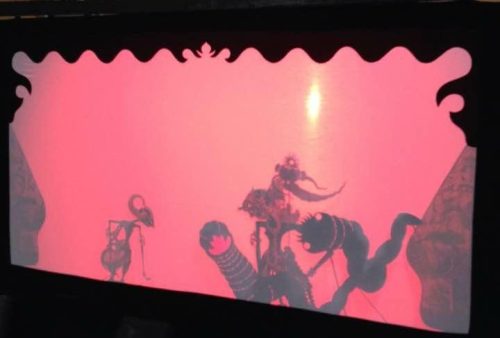
Rama & the Worm (2017)
-
- WOMAD New Zealand (2012)
- European tour to Netherlands, Germany, and Italy (2003)
- WOMAD New Zealand (2003)
- Year-long residency in Glasgow, Scotland (2002)
- Puppet and opera Wayang Esther (with Barbara Benary), New York, USA (2001)
- Bima Builds a Kingdom, Millenium Stage, Kennedy Centre, Washington DC, USA (2001)
- Wayang Karetao at ‘Beat’ International Gamelan Festival, Wellington, New Zealand (1999)
- International Puppetry Festival, Jakarta, Indonesia (1999)
- Television broadcast on Television New Zealand (1997)
- Bi-lingual (Javanese-English) performance at the International Conference of Art for the Future, Bali (with Kathryn Knox and Matthew Cohen), Indonesia (1990)
Collaborations and Experimental Work
Joko has worked with others to produce experimental collaborative shows that tell stories local to various places, often designing and creating puppets specific to the occasion himself. These have included:
-
- In Aotearoa New Zealand, Wayang Karetao - the first such collaboration for Joko, particularly important for its relationship to the indigenous Māori of the country (1997-2003; see below); Rama & the Worm short film with Dan Bendrups (La Trobe University) and Donal Stewart (Griffith University)
- in Scotland: Wayang Cuchulain & Wayang Skotlandia with Matthew Isaac Cohen and Gamelan Naga Mas (2002)
- in Tasmania, Ubu Bush Pig at the University of Tasmania, Launceston (2003)
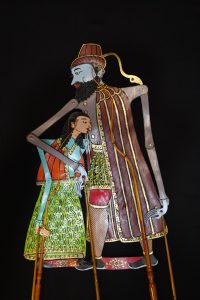
- in the USA, Wayang Esther, with Barbara Benary and Gamelan Son of Lion in New York (2001); revised and revived in 2022 with newly designed puppets by Joko Susilo
- in the Netherlands, Wayang Revolusi with Gamelan Widosari (2005)
Puppets designed by Joko Susilo for Wayang Esther 2022:
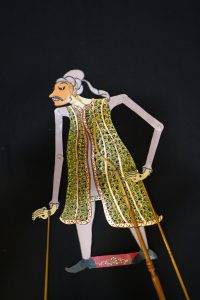
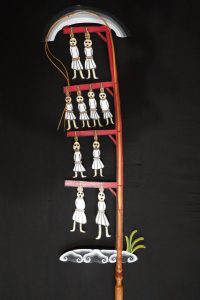
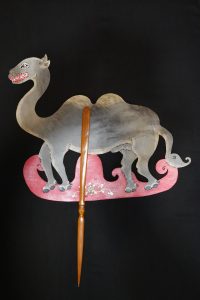
Wayang Karetao (1997-2002)
This collaboration between Javanese shadow puppetry and Māori actors and playwrights was first conceived by Jack Body of Victoria University of Wellington around 1995. Working with local Māori artists, this innovative art form adapts the techniques of Indonesian shadow puppetry to relate Māori pūrākau (stories) from the South Island. Karetao is the Māori term for puppets that have previously been only known from static museum collections, but have recently seen a revival in an active performing art.
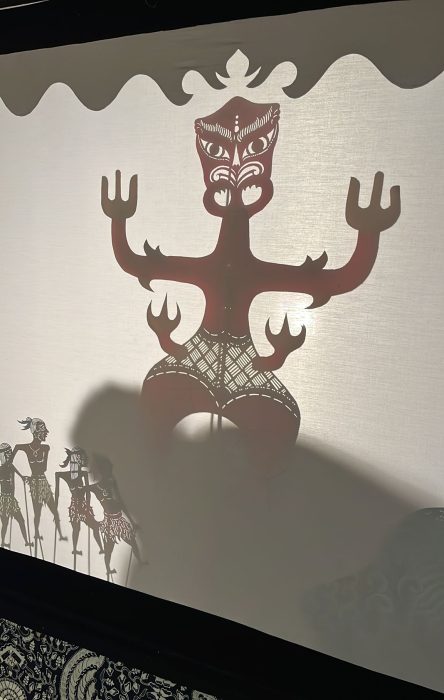
The first wayang karetao performance was at the Aoraki Festival in Timaru in 1997. The story was “Summer Starlight Winter Moon” by John Broughton, and used hand puppets, shadow puppets, human shadows, Māori movement in front of the screen, and projector slides.
The concept was further developed in 1999 into an adaptation of three pūrākau: Pouakai, a great eagle that once terrorised Canterbury; Kopuwai, a monster with the head of a dog and the body of a man; and Whakatu Kararahua, the story of a great lizard that devoured people from Rapuwai villages.
Joko worked with Awatea Edwin (Kai Tahu, Kati Mamoe, Waitaha, Rapuwai) as well as Richard Huber (Theatre Studies, University of Otago) and John Broughton (Ngāti Kahungunu, Ngāi Tahu) to develop this show. He was joined in the performance by Debbie Hore and Andrew McKenzie (Ngati Whatua), both graduates of Theatre Studies at the University of Otago, and Yono Sukarno of Wellington.
This show was performed twice at the BEAT! International Gamelan Festival in Wellington and later in the year at the Aoraki Festival in Timaru.
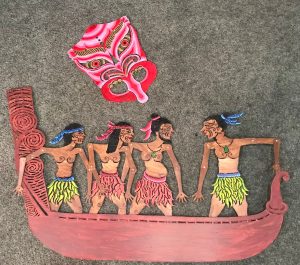
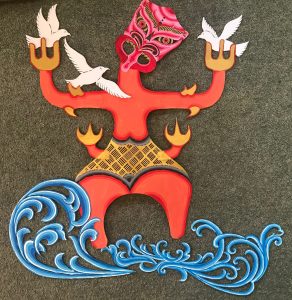
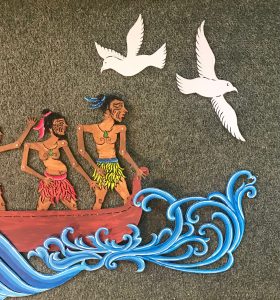
The show featured custom-made puppets created by Joko, blending aspects of Māori and Indonesian art. Their design differed from traditional wayang kulit, being made from cardboard, which lacks the pliability of the traditional leather, and each puppet had five handles instead of the usual three.
Another innovation for the show was the use of a kehua (spirit) puppet with a movable head as the kayon, to represent a storm, the wind, or fire, for example, in a similar way to the kayon in traditional Javanese wayang kulit.
The performance incorporated movement and haka performed by two actors interrelating in front of the screen, with the shadow puppets behind, as well as gamelan music. Two puppet pou (images of Māori gods) were placed beside the screen with lights in their eyes and featured in the opening of the show as the actors performed actions through the pou in time with a karakia (prayer or chant).
Joko also presented a further story “The big fish of Maui” at the West End Festival in Glasgow, Scotland in 2002.